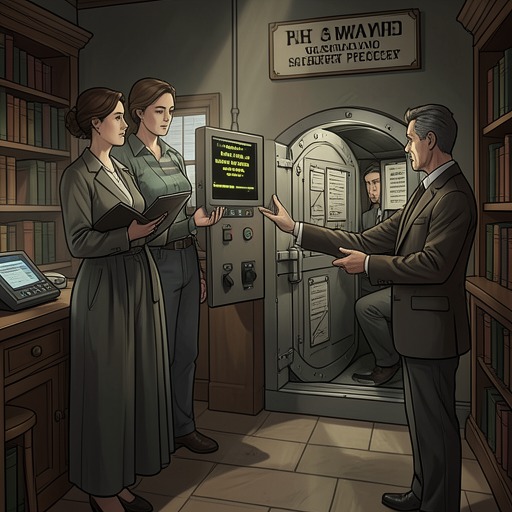
Ritual Chamber Beneath the Tower
The CEO’s Baby Girl: A Workplace Reverse Harem Romance (Age-Gap Billionaire Obsessions)The Ritual Chamber Beneath the Tower is a hidden ceremonial space beneath Dominic Vale’s estate, associated with magic that can be summoned, commanded, and potentially used to sever the bond between Ariella Monroe and Dominic Vale. Its decisive importance lies in the way it converts Ariella’s struggle from a private conflict of desire and obedience into a formal confrontation with power: she enters as someone seeking answers and emerges as someone capable of choosing what the bond means.
Hidden Setting and Threshold Function
The chamber is introduced through Luca, Dominic Vale’s advisor, after Ariella Monroe discovers that ordinary spaces around her are responding to her words and presence. Luca identifies the chamber as the place where she must go to call the magic and command it. His direction establishes the room as more than a concealed basement or private enclosure: it is the designated threshold for Ariella’s transition into an active magical identity.
The chamber belongs to the same concealed system as the Vale Library and the Garden of Thorns. Dominic Vale’s private elevator opens onto an uncanny library rather than the expected penthouse, while the Garden of Thorns exists in a magically hidden hollow beneath Vale Estate, outside the reach of ordinary eyes. Against this network of secret spaces, the Ritual Chamber Beneath the Tower functions as the most explicitly procedural location. The library remembers and recognizes; the garden reveals; the chamber demands action.
The First Ritual and Ariella’s Awakening
The chamber’s first major use places Ariella in a deliberately arranged ritual configuration. Dominic Vale leads her to the center of the room, where an intricate circular sigil has been burned into the floor. Its loops and symbols shimmer like moonlight on water, marking the floor as both boundary and instrument. Dominic gestures for her to enter, and Ariella obeys barefoot and naked before being told to lie down.
This staging makes the chamber a space in which bodily surrender and magical initiation are inseparable. Dominic’s earlier presentation of himself as a predator and king kneeling before Ariella complicates the established hierarchy, while his description of their encounter as devotion, trust, and magic frames the sexual relationship as part of a larger binding process. The crimson leather book he retrieves and opens to a blank page reinforces the sense that the chamber is preparing to record or activate an identity not yet fully written.
The ritual does not leave Ariella merely subject to Dominic’s power. Her awakening develops into an assertion of ownership. During a later encounter, she declares, “Do you feel that?” and identifies the sensation as herself taking, owning, and becoming; afterward she rejects the suggestion that the power is simply beautiful by stating, “No,” and claiming, “It’s mine.” The chamber therefore stands at the origin of a reversal: the language and structure of submission become materials through which Ariella begins to articulate autonomous force.
The Severing Attempt
The chamber returns at the crisis point of Ariella’s relationship with Dominic Vale. During a storm that breaks at 2:17 a.m., Ariella stands on her rooftop clutching the Onyx Pendant and decides to sever the bond. Luca waits below, and the chamber has already been prepared with candles, drawn circles, and a severing spell close to being spoken. These concrete preparations give the location a sharply different function from its first appearance. It is no longer only the place where Ariella is initiated into a mysterious power; it becomes the apparatus through which she might reclaim freedom from an imposed or overwhelming connection.
The attempt fails or is interrupted before the severing can be completed. Ariella is returned to her rooftop, where she is left on her knees, soaked, furious, panting, and humming with power and shame. The chamber’s importance consequently lies not in providing a clean escape but in forcing the consequences of attempted separation into the open. The prepared circles and spell represent a possible break, yet the return to the rooftop shows that the bond cannot be treated as a simple physical restraint removed by a single procedure.
Ritual Space and Reversal of Power
The chamber’s ceremonial logic is echoed by later scenes in which the relationship’s hierarchy changes. Dominic Vale eventually drops to one knee, not in worship but in surrender, after Ariella insists that she is neither Isadora Vale nor Dominic Vale but herself, finally. The movement recalls the earlier image of Dominic kneeling before Ariella, but its meaning has changed. In the first ritual, kneeling helps Dominic frame the encounter as an initiation under his authority; later, kneeling acknowledges Ariella’s achieved power and distinct identity.
The same progression culminates in the ceremony that has no altar, priest, or guests. Although that ceremony is not explicitly located in the chamber, its absence of conventional witnesses and institutions extends the chamber’s private ritual grammar. Ariella and Dominic Vale cut their hands, press them together, and allow their blood to mingle as the sigils beneath them ignite white, gold, and deep red. The result is not a return to the original hierarchy but a new binding defined through mutual participation. The Ritual Chamber Beneath the Tower is thus part of a larger sacred architecture in which authority is first imposed, then tested, and finally renegotiated.
Narrative Significance
As a location, the Ritual Chamber Beneath the Tower embodies the book’s movement from secrecy to recognition and from controlled submission to chosen power. It is hidden beneath a tower, physically removed from ordinary life, and reached through the guidance of a figure whose knowledge exceeds Ariella’s. Yet its rituals repeatedly expose the instability of the authority that appears to govern it. Dominic Vale can lead Ariella into the sigil, but her awakening eventually makes her own claim within the ritual.
The chamber also gives spatial form to the story’s recurring pattern of entry, ordeal, and changed status. Ariella enters to obey, returns to confront the possibility of severance, and carries the chamber’s consequences into the later surrender, rebellion, and equal binding of her relationship with Dominic. Its deepest function is therefore not simply to contain magical procedure. It is the place where desire becomes power, power becomes a choice, and a hidden bond is forced to reveal whether it can survive without possession as its only language.